

Want a verse on every screen? Psalmo is free.
Bible Verses for Depression: 6 KJV Scriptures That Hold You
Depression has a specific texture, heavier and quieter than worry or nighttime fear. Motivation won’t come. Color drains from things that used to matter, effort costs more than it returns, and sleep doesn’t restore.
The biblical tradition knows this condition in detail. Nearly 40% of the Psalter is lament, not praise. Elijah in 1 Kings 19 asks to die after his greatest ministry success. Jeremiah writes Lamentations from inside total collapse. Scripture doesn’t route around depression. It records it in careful detail and addresses it directly.
These six KJV Bible verses for depression carry Hebrew vocabulary that names the condition precisely rather than softening it with generic comfort. Each one was chosen for a different dimension of how depression actually presents.
The strongest KJV Bible verses for depression are Psalm 42:11 (shaphal = collapsed under weight), Lamentations 3:22-23 (mercies renewed daily), Psalm 30:5 (rinnah = dawn-shout after weeping), Isaiah 43:2 (passing through, not drowning), Psalm 147:3 (God binds the shattered), and 1 Kings 19:4-5, the Bible’s clearest portrait of depressive collapse and God’s response to it.
What Depression Looks Like in Scripture
Depression affects roughly 280 million people worldwide, according to the World Health Organization, and 29% of US adults have received a depression diagnosis at some point in their lives, per APA 2023 data. It’s distinct from situational grief, from the overload of stress, and from nighttime anxiety, though all four can coexist. The biblical tradition engages depression at length: approximately 42 of the 150 Psalms are lament psalms, where the writer describes spiritual darkness, divine distance, exhaustion from unanswered crying, and an inability to function normally. Elijah asks to die in 1 Kings 19 after his greatest ministry moment, then sleeps twice while an angel provides food and water. Jeremiah writes Lamentations from inside total collapse, describing being driven into darkness and walled in so that he can’t get out. The Hebrew vocabulary across these passages includes shaphal (bent low, collapsed under weight), shachah (bowed to the ground), and dakah (crushed into pieces). Scripture’s first response to Elijah’s depression is presence, rest, and physical provision, before any instruction is given.
The six passages below each target a different dimension of how depression presents. Start with the one that fits where you are right now.
6 KJV Bible Verses for Depression
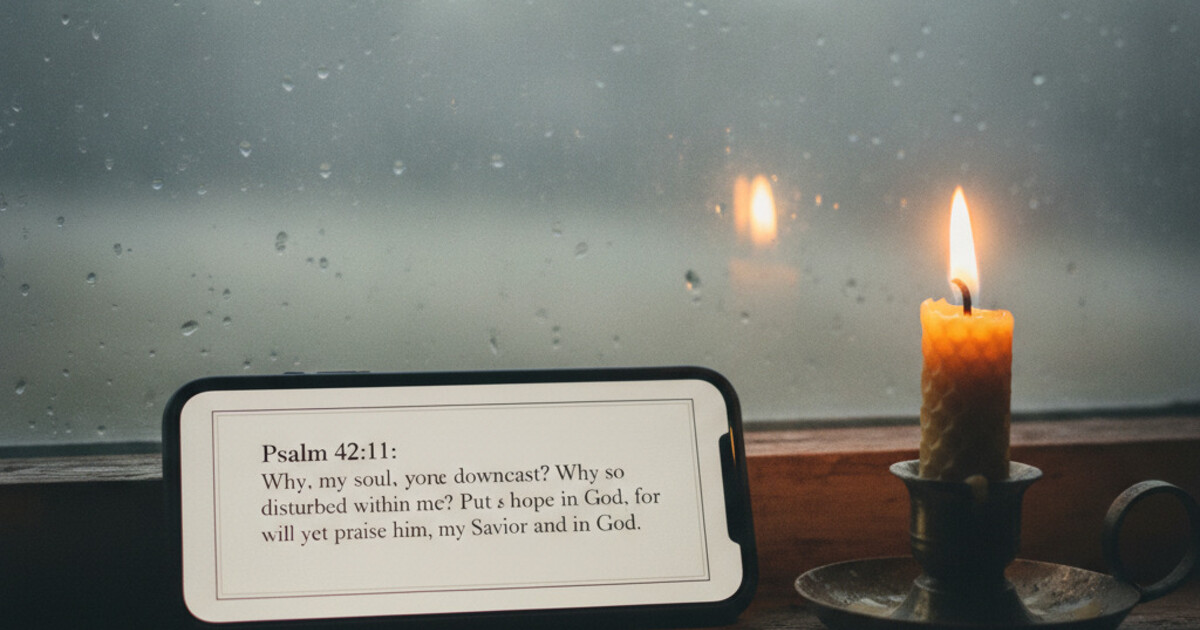
Psalm 42:11 (KJV): Named and Not Abandoned
“Why art thou cast down, O my soul? and why art thou disquieted within me? hope thou in God: for I shall yet praise him, who is the health of my countenance, and my God.”
The Hebrew word for “cast down” is shaphal, which goes past sadness. It means bent low under a weight, physically collapsed, the way a person folds when something too heavy is placed on them. The psalmist isn’t analyzing the condition from a recovered position. The writer is inside it, asking the same question a depressed person asks: why is this happening to me?
“Disquieted” is hamah, a word that appears elsewhere for the roaring of a sea or the churning of a crowd. The interior of depression isn’t quiet. The verse knows this and names both the weight and the noise inside it.
“I shall yet praise him” is future tense, not present. The psalmist doesn’t manufacture praise from inside the low place. The verse permits staying in the question while pointing toward what’s coming.
Lamentations 3:22-23 (KJV): Mercies That Renew Daily
“It is of the LORD’S mercies that we are not consumed, because his compassions fail not. They are new every morning: great is thy faithfulness.”
The Hebrew chesed, translated “mercies,” isn’t sentimentality. It’s covenant loyalty, the committed faithfulness of a relationship that holds regardless of what the other party can offer in return. Chesed doesn’t require you to feel grateful or functioning for it to apply. It applies because of the covenant, not because of your emotional state.
Racham, translated “compassions,” shares its root with the Hebrew word for womb: the visceral, protective care a mother has for a child she carried. It precedes the child’s ability to perform.
Chadash, translated “new every morning,” means renewed, not replaced. The same chesed returns. You don’t start over from zero. The faithfulness that held yesterday is the same faithfulness that shows up again.
Psalm 30:5 (KJV): Weeping Has a Duration
“For his anger endureth but a moment; in his favour is life: weeping may endure for a night, but joy cometh in the morning.”
The Hebrew word for “weeping” is bekhiy, which means weeping as a settled condition, not a passing moment. The verse takes duration seriously. Weeping endures through the night. That’s an honest acknowledgment that the low place doesn’t resolve by tomorrow morning.
Rinnah, translated “joy,” carries a specific meaning: the shout of deliverance a soldier gives when a battle turns, the crowd-noise of victory after a siege breaks. It was used for the shout Israel gave when they saw the Red Sea close over Pharaoh’s army.
The verse holds both: weeping through a night, and rinnah when it ends.
Isaiah 43:2 (KJV): Passing Through, Not Drowning
“When thou passest through the waters, I will be with thee; and through the rivers, they shall not overflow thee: when thou walkest through the fire, thou shalt not be burned.”
The Hebrew avar, translated “passest through,” means to cross from one side to the other. The word implies motion and an exit point. You’re crossing through something, not inhabiting it permanently.
“They shall not overflow thee” is specific. The water and river are real. The promise locates you above the waterline while passing through, not in a place where the water is absent.
This verse was written to Israelites in Babylonian exile, people who had lost their city, their temple, their national identity, and their sense of God’s presence. It wasn’t addressing hypothetical difficulty. It was written into the middle of it.
Psalm 147:3 (KJV): The Healer Binds What’s Shattered
“He healeth the broken in heart, and bindeth up their wounds.”
“Broken in heart” is nishberei-lev, from the verb shabar: to shatter, the way pottery breaks, the way bones break. The word appears elsewhere for the breaking of cisterns, the smashing of images, the collapse of something that was intact. Depression can carry this quality, not merely sadness but the sense that something whole has broken and won’t reassemble.
“Healeth” is rapha’, the same root as the name Raphael (God heals). “Bindeth up” is chabash: to bind up the way a field medic dresses a wound, pressing clean cloth against the injury and fastening it in place. The image is active, immediate, and physical. Contact with the wound, not symbolic healing at a distance.
1 Kings 19:4-5 (KJV): Elijah Under the Broom Tree
“But he himself went a day’s journey into the wilderness, and came and sat down under a juniper tree: and he requested for himself that he might die; and said, It is enough; now, O LORD, take away my life; for I am not better than my fathers. And as he lay and slept under a juniper tree, behold, then an angel touched him, and said unto him, Arise and eat.”
This is the most direct biblical narrative of depression. Elijah has just won a contest against 450 false prophets. A week later he’s in the desert asking to die. The Hebrew word translated “juniper tree” is rotem, which botanists identify as the white broom shrub, a desert plant with thin shade.
Elijah didn’t find a comfortable place to collapse. He found whatever cover was available and lay down.
God’s response is striking in what it doesn’t do. No rebuke. No instruction. The angel touches him, a word (nagaʿ) that means physical contact, and says: Arise and eat. Twice. Food, water, and sleep across two visits before any movement is required. The first thing God provides for the depressed prophet is rest and nourishment, not correction and a task.
The passage permits staying where you are long enough to be fed.
How to Sit With These Verses When Concentration Is Hard
Depression slows cognition. Tracking a long argument through a Bible chapter is harder when you’re in the low place than when you’re not. One verse is often more useful than a chapter.
A single verse on a phone’s lock screen, or said aloud once in the morning, does something different than reading it in a stack of chapters you can’t hold. Phillippa Lally’s 2010 research at University College London found that attaching a practice to a consistent daily trigger, at the same point each day, builds durable habit associations over an average of 66 days. The trigger matters as much as the content.
Two things that work when active engagement is too much:
- Leave the verse visible somewhere you’ll encounter it without deciding to. A widget on the home screen, a card on a kitchen counter.
- Read it aloud once, even quietly. Speaking slows processing and moves the words out of the abstract reading layer.
Consistency at a repeated trigger does more over weeks than intensity at a single moment.
How Psalmo Helps During Depression
Psalmo puts a rotating Bible verse on your iPhone or Android home screen and lock screen, drawn from categories you choose. The Hope, Healing, and Peace & Anxiety categories pull from comfort passages suited to depression. The verse refreshes at midnight by default, or hourly if you want more variety.
The widget shows in all three sizes without opening the app. During depression, reducing the number of steps between you and a piece of scripture matters. Zero steps is better than one.
If depression is compounded by social media spirals, Psalmo can pause Instagram, TikTok, X, YouTube, or Snapchat until today’s verse has been read. Scripture before the feed rather than after it. The bible verse for stress article covers six KJV passages for the overload and depletion that often accompanies depression. The bible verse for worry article covers six distinct KJV passages for the thought-loops that can run alongside low mood. The bible verse widget for anxiety guide walks through Psalmo’s widget setup and Peace & Anxiety category on both platforms.
Download Psalmo free from the App Store or Google Play. The Hope, Healing, and Peace & Anxiety categories, the daily verse widget, and the app-gating feature are all available at no cost.
Keeping the verse somewhere you’ll see it without opening anything helps on the days you won’t; the free Bible verse widget comparison covers the no-subscription options.
Frequently Asked Questions
What is the best Bible verse for depression?
Psalm 42:11 is often the most immediately resonant because it doesn’t bypass the condition. The Hebrew shaphal (cast down) means collapsed under weight, not merely sad. The psalmist is inside the low place while writing, asking the same question a depressed person asks: why is this happening to me? The verse names both the weight and the churning noise inside it before pointing toward what’s coming. It’s a lament, not a pep talk, which is why it lands differently than comfort-only verses.
What does the Bible say about depression?
The Bible records depression at length without spiritually bypassing it. Elijah asks to die in 1 Kings 19 after his greatest ministry moment. David describes sustained low states across multiple Psalms using shaphal (collapsed), shachah (bowed to the ground), and dakah (crushed). Jeremiah writes Lamentations from inside total loss. The biblical response to depression, modeled in 1 Kings 19, begins with presence, rest, and physical provision before any instruction or direction is given.
Is depression a sin in the Bible?
The Bible doesn’t treat depression as sin. Elijah’s collapse in 1 Kings 19 happens right after his most successful ministry moment, and God’s response is touch, food, and sleep, not correction. David writes lament psalms from inside sustained low states that sound clinically depressive by modern criteria. The pattern across the text is bringing the condition to God rather than concealing it, and returning to that honesty as many times as needed.
How do you use Scripture when you’re too depressed to pray?
One verse is more accessible than a chapter when cognition is slow. Reading it aloud once, even quietly, does something different than silent reading. If forming words feels too hard, keeping the verse visible without deciding to engage, on a home-screen widget or a piece of paper on a desk, lets it work in your peripheral view. Depression slows processing, so a single image or phrase seen repeatedly across a day does more than one intentional reading session.
What Bible verse helps with hopelessness?
Lamentations 3:22-23 addresses hopelessness through what remains rather than what you can feel: God’s mercies renewed every morning. The Hebrew chesed (covenant loyalty) doesn’t require the recipient to feel it to apply. Racham (womb-compassion) precedes performance. The verse works when hope as a feeling has gone flat because it anchors in covenant faithfulness rather than emotional experience. The promise doesn’t depend on your ability to feel it.