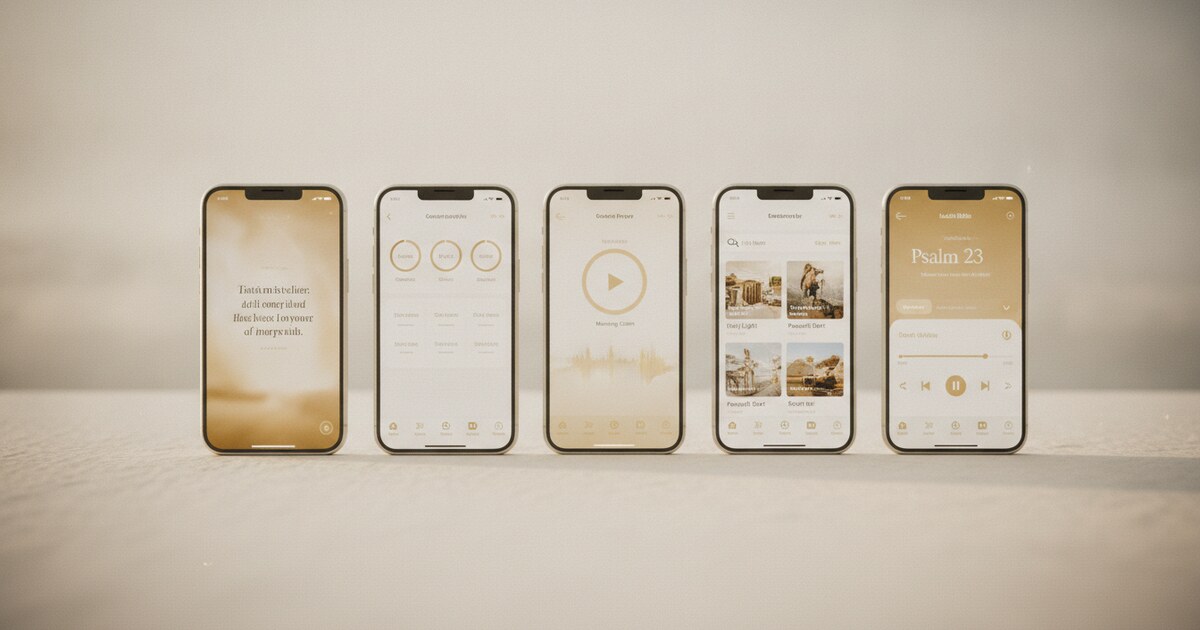

Want a verse on every screen? Psalmo is free.
What Does the Bible Say About Phone Addiction?
Smartphones have been in everyone’s pockets for about 15 years. The New Testament is 2,000 years old. There’s no verse about Instagram, no chapter on TikTok. So when people ask what the Bible says about phone addiction, the honest first answer is: nothing, directly.
But that’s not the whole answer. The Bible addresses the mechanisms that phone addiction runs on: divided attention, compulsive repetition, habituation to a master, and what you allow to flow through your eyes into your mind. Strip away the device and look at the behaviors it produces, and the scripture gets surprisingly specific.
This article walks through the passages that apply, why they apply, and what they suggest doing about it. Not a verse list. A diagnosis.
The Bible doesn’t mention phones, but it addresses the mechanics of compulsion directly. 1 Corinthians 6:12 asks whether a lawful thing has become your master. Philippians 4:8 commands active attention management. Romans 12:2 warns against being press-molded by external culture. Three passages, written centuries apart, that describe exactly what phone addiction does to a person.
What the Bible Actually Says About Phone Addiction
The Bible was written centuries before smartphones existed and contains no direct reference to phone use or digital addiction. But it addresses the mechanics underneath addiction with unusual precision. 1 Corinthians 6:12 (KJV) states: “All things are lawful unto me, but all things are not expedient: all things are lawful for me, but I will not be brought under the power of any.” The phrase “brought under the power” translates exousiasthēsomai, meaning to be mastered or owned. That’s the biblical category for compulsion: not whether an activity is permitted, but whether it’s running you. Romans 12:2 adds the cultural dimension: “be not conformed to this world.” The Greek syschematizesthe means to be press-molded into the shape of the age. Philippians 4:8 sets a positive filter through logizomai, an accounting verb meaning to actively choose what occupies the mind. These passages describe what phone addiction exploits before smartphones existed.
That framing shifts the question to a more useful one: does this activity master me, and am I letting a platform’s design shape my attention habits? Those questions produce more traction than asking whether checking your phone is sinful.
Christians who’ve worked through this tension often land in the same place: Paul’s argument in 1 Corinthians 6 is about power over behavior, and it’s structural. He’s describing a functional failure, something that started as a free choice and became a compulsion. That’s exactly the arc phone use follows for a lot of people.
Why the Scroll Grips You: The Eye Gate in Scripture
Phones exploit variable reward. You don’t know whether the next scroll will bring something funny, alarming, a new like, or nothing at all. That unpredictability is what makes checking compulsive, the same mechanism behind slot machines. B.F. Skinner documented variable-ratio reinforcement in the 1950s; behavioral researchers have since confirmed it applies directly to smartphone notification patterns.
Psalm 101:3 (KJV) speaks to the input side: “I will set no wicked thing before mine eyes.” The Hebrew ra’, translated “wicked,” carries the sense of worthless or harmful. The verse frames the eye as a gate: what you let through shapes what happens inside.
Proverbs 4:23 follows the same logic from within: “Keep thy heart with all diligence; for out of it are the issues of life.” The Hebrew natsar means to guard like a watchman at a city gate, standing watch and deciding what passes through. A phone that auto-refreshes news and social feeds into your field of vision is, functionally, a machine for keeping that gate open all day.
The sequence these two passages form is significant. What you let through the eye gate (Psalm 101:3) shapes the heart (Proverbs 4:23), which shapes life’s direction. Phone platforms are engineered to bypass the guard as often as possible. The average smartphone user in the US checks their device 96 times daily (Asurion, 2023). At that rate, the watchman never rests.
Three Passages That Name Phone Addiction Directly
These three passages don’t require strained interpretation to apply here. Each addresses a specific behavioral pattern that compulsive phone use produces.
1 Corinthians 6:12 is the most precise. Paul writes: “All things are lawful unto me, but I will not be brought under the power of any.” His logic centers on whether a lawful thing has become your master. If you reach for your phone without deciding to, check it mid-conversation, or feel anxious when you can’t access it, exousiasthēsomai applies. You use the app; the app also runs you.
Ephesians 5:15-16 adds a time argument: “See then that ye walk circumspectly, not as fools, but as wise, redeeming the time, because the days are evil.” The Greek exagorazo means to buy something back from the marketplace, to recover what’s been traded away without noticing. DataReportal’s 2025 report puts daily mobile screen time at 4 hours and 37 minutes. The verse asks: how much of that was deliberate?
Matthew 6:22-23 addresses fragmented attention: “The light of the body is the eye: if therefore thine eye be single, thy whole body shall be full of light. But if thine eye be evil, thy whole body shall be full of darkness.” The Greek haplous, translated “single,” means undivided, focused, whole. A scattered eye scanning multiple feeds fits the second clause more than the first. Jesus frames this not as a moral verdict but as a functional reality: a divided eye fills the body with darkness the same way a focused eye fills it with light.
Together these three passages cover the compulsive loop at every stage: the mastery question (1 Cor 6:12), the time-cost question (Eph 5:15-16), and the attention question (Matt 6:22-23). None of them require a smartphone to be present. All of them were written for exactly this kind of problem.
Turning These Principles Into a Phone Habit
The passages above converge on a practical question: how do you interrupt the compulsive loop?
Willpower is the wrong tool. The research on habit formation (Phillippa Lally’s 2010 UCL study) shows that breaking an existing habit takes 66 to 254 days of consistent alternative behavior. That’s not a resolution problem; it’s a structure problem. Intentions don’t hold against a device that’s been professionally optimized to bypass them.
One concrete structural answer is friction: put something worthwhile between you and the reflexive tap. The articles on how to use the Bible to stop phone addiction and Christian apps for phone addiction cover this in detail. The short version: Philippians 4:8 is a command, stated in the active imperative. Logizomai is an active directive: do this deliberately, right now, before the default kicks in.
A verse gate makes this structural rather than willpower-dependent. Psalmo gates any apps you choose behind a Scripture passage. Before Instagram, TikTok, X, YouTube, or Snapchat opens, you read a verse, 3 verses, or a chapter. The apps stay accessible afterward for a window you set (15 minutes to 4 hours), then lock again. The mechanism is logizomai made physical: Scripture enters first, before the scroll can claim the next 45 minutes of your attention without permission.
This works alongside the daily verse widget, which puts today’s passage on your home screen or iPhone lock screen. You see Scripture the moment you pick up the phone, before the notification count loads. That’s Proverbs 4:23 in practice: the watchman is standing at the gate before the feed arrives.
Psalmo’s app-gating feature, daily verse widget, and offline Bible reader in 19 translations are all available on the free plan, on iOS and Android, with no account required.
Frequently Asked Questions
Is phone addiction a sin according to the Bible?
The Bible doesn’t frame compulsion in legal categories. 1 Corinthians 6:12 asks whether something has mastered you; that’s the relevant question. Compulsive phone use fits the biblical category of bondage rather than guilt over a lawful activity. The remedy Scripture points toward is liberation and restructured habits, not confession for using a permitted technology.
What Bible verse helps most with phone addiction?
1 Corinthians 6:12 is the most diagnostic: “I will not be brought under the power of any.” It frames the question correctly as mastery, not morality. Philippians 4:8 is the most actionable: an active command to choose what occupies your mind rather than letting a feed choose for you. Use 1 Cor 6:12 to diagnose the problem and Phil 4:8 as the daily directive.
Does the Bible address social media specifically?
Romans 12:2 addresses the mechanism: “be not conformed to this world.” Social media platforms are engineered to press-mold your attention, emotional state, and desires into shapes that serve the platform’s interests. Choosing how and when you engage is the Romans 12:2 response applied to a 2026 context.
How do I use Scripture to reduce phone use practically?
The most durable approach is structural rather than willpower-dependent. Put a verse before every social app opening, not as a devotional ritual but as a way of doing what logizomai describes: actively choosing what enters your mind before the algorithm gets a turn. A daily verse widget on your home screen or a Scripture gate on your most-used apps builds this into your phone’s structure as a system, not a daily decision.
Psalmo is free to download on iOS and Android. The verse gate, home-screen widget, and Bible reader all work on the free plan, with no subscription required.