Want a verse on every screen? Psalmo is free.
Bible Verse Before Bed: Best Verses + App (2026)
Most nights, the last thing people look at before turning out the light is their phone. For most of them, that’s a social feed. A bible verse before bed swaps that final glance for something that actually settles the day, and once the habit’s in place, it takes about 30 seconds.
The verses that land best at bedtime are different from the ones that work in the morning. Morning verses carry intention into the day. Bedtime verses give the mind somewhere settled to land after the day is done. This guide covers the five KJV verses that hold up best at night, why reading scripture before sleep works, and how to build the habit so it runs without any effort on your part.
A bible verse before bed replaces variable-reward scrolling with a fixed focus point, giving the mind somewhere settled to land. The best KJV bedtime verses are Psalm 4:8, Proverbs 3:24, Philippians 4:6-7, Matthew 11:28, and Psalm 121:3-4. Psalmo puts a verse on your lock screen every night and sends a notification at your chosen hour, free on iOS and Android.
Why a Bible Verse Before Bed Works
The National Sleep Foundation’s 2023 poll found that 60% of US adults check their phone within 30 minutes of bedtime, with 44% checking social media. The American Psychological Association’s 2022 Stress in America survey found that 58% of US adults lay awake due to stress at least once in the prior month. Reading a bible verse before bed counters both patterns through cognitive deceleration: slowing the brain’s alertness cycle before sleep. Social feeds deliver variable rewards (new content, notifications, reactions) that keep the prefrontal cortex scanning for what comes next. A fixed verse gives the mind a single settled point to land on. Philippians 4:7 (KJV) offers a specific anchor: “the peace of God, which passeth all understanding, shall keep your hearts and minds through Christ Jesus.” Phillippa Lally’s 2010 UCL study found that pairing a new behavior with a consistent physical anchor is the most reliable way to build a durable habit. Charging your phone before bed is one of the most consistent acts of the night.
Once the habit is wired in, the lock-screen widget does the work for you. A verse is there every time you pick up your phone to plug it in, with no app to open and no reminder to set.
Best Bible Verses to Read Before Bed
These five KJV verses cover the main emotional registers of a close of day: peace, safety, release, rest, and protection. Start with one. Habits form faster around a single anchor.
Psalm 4:8 — For a Settled Mind
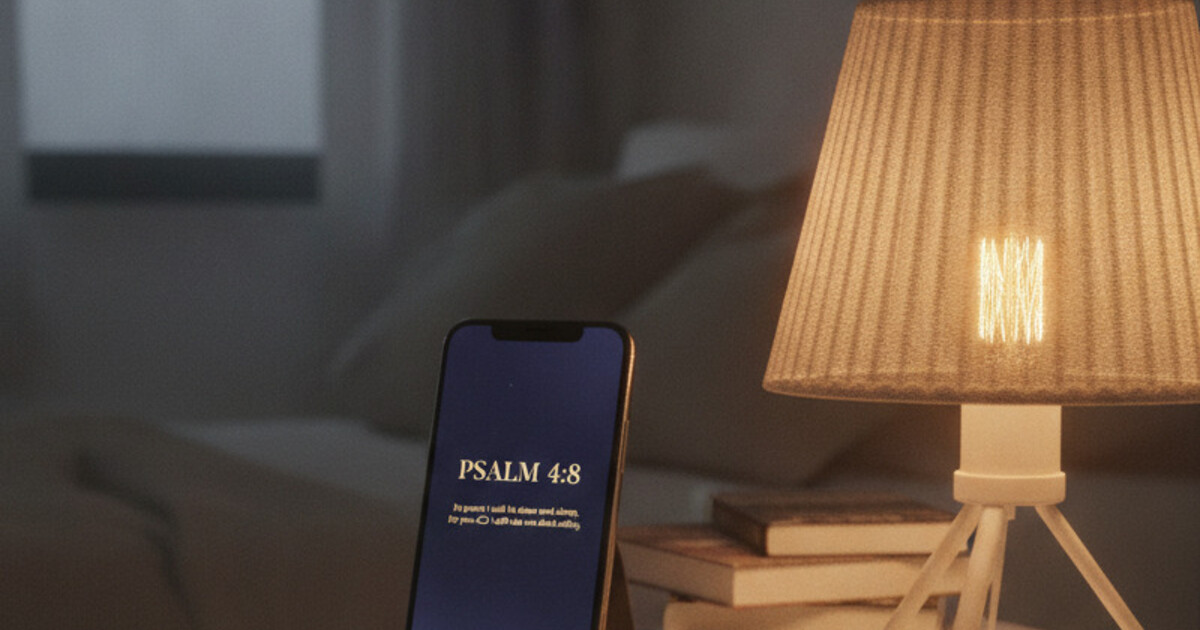
“I will both lay me down in peace, and sleep: for thou, LORD, only makest me dwell in safety.”
Psalm 4:8 is one of the oldest and most direct bedtime prayers in scripture. David wrote it while fleeing Absalom. The peace here is rest inside trouble. The Hebrew shaqat (laid down, quieted) means an active settling. Reading it is a declaration that the day is closed and you’re safe.
Proverbs 3:24 — For Anxiety Before Sleep
“When thou liest down, thou shalt not be afraid: yea, thou shalt lie down, and thy sleep shall be sweet.”
Proverbs 3:24 reads like a prescription. The promise is specific: you’ll lie down, you won’t be afraid, and your sleep will be good. The Hebrew areb (sweet, pleasant) is the same word used for fragrant spices in Song of Solomon 7:13. That level of specificity is what makes a verse useful as a bedtime anchor rather than vague comfort. For nights when the worry won’t quit, this one names the problem directly and meets it.
Philippians 4:6-7 — For a Worried Day
“Be careful for nothing; but in every thing by prayer and supplication with thanksgiving let your requests be made known unto God. And the peace of God, which passeth all understanding, shall keep your hearts and minds through Christ Jesus.”
Philippians 4:6-7 works best on the nights when you can’t stop running through tomorrow. “Be careful for nothing” is the KJV translation of merimnate, meaning don’t be anxious about a single thing. The sequence is practical: name the worry, bring it in prayer, and receive the peace that follows. It’s one of the few bedtime passages that treats anxiety as something to actively hand off rather than suppress through willpower.
Matthew 11:28 — For Exhaustion
“Come unto me, all ye that labour and are heavy laden, and I will give you rest.”
Short, direct, and suited to the nights when there aren’t words for the day. Jesus isn’t asking anything in return here. The Greek anapauo (rest, give relief) was used for refreshing a worn-out traveler. If a longer passage feels like too much when you’re tired, this one works as a complete single-sentence prayer.
Psalm 121:3-4 — For Late-Night Worry
“He will not suffer thy foot to be moved: he that keepeth thee will not slumber. Behold, he that keepeth Israel shall neither slumber nor sleep.”
Psalm 121:3-4 works by flipping the perspective. You need sleep; God does not. That asymmetry is reassuring in a way that comfort verses often aren’t: whatever you’re carrying doesn’t need to be held in consciousness through the night because something else is already watching. For parents, for people in a difficult season, for anyone who wakes at 3am with a running mind: this verse does something different than a general peace verse does.
How to Build the Before-Bed Habit
A verse on a bookmark doesn’t build a habit. A verse on your lock screen does, because the trigger (charging your phone for the night) happens every night without any effort on your part.
Step 1: Pick one verse. Start with a single verse from the list above, not all five. Choose the one that fits your current season: Proverbs 3:24 if sleep anxiety is the problem, Matthew 11:28 if exhaustion is, Psalm 121:3-4 if you wake in the night with a running mind.
Step 2: Set up a lock-screen widget. On iPhone (iOS 16+), long-press your lock screen, tap Customize, and add the Psalmo widget. On Android, long-press your home screen, select Widgets, and drag Psalmo to a screen you see before bed. The full step-by-step is in the how to add a Bible verse widget to your iPhone guide.
Step 3: Turn on a bedtime notification. Open Psalmo’s Settings and set the notification time to 30 minutes before your usual sleep hour. A notification interrupts the scroll before it starts rather than competing with it once the phone’s already open. For the full breakdown of how notification timing works across apps, the daily bible verse reminder app comparison covers each option in detail.
Step 4: Select rest-appropriate categories. In Psalmo’s Settings, turn on Evening Verses and Peace and Anxiety. Turn off Work and Purpose and Strength and Courage if you want a calmer verse pool at night. The daily verse draws only from your active categories, so this step determines the tone of what shows up.
Best App for a Before-Bed Bible Verse Habit
Three apps come up most for bedtime scripture use: Psalmo, YouVersion, and Abide.
Psalmo is the best fit for a lock-screen bedtime habit. It shows a verse on your home screen and lock screen (iPhone, iOS 16+), sends a notification at whatever time you set, and lets you filter by category (Evening Verses, Peace and Anxiety, Psalms) for tone control. The Night Sky theme (dark background, gold text) and the Dark theme both hold up in low-light environments. The full free tier covers all of this. The one extra worth enabling: the app gate, which requires reading today’s verse before Instagram, TikTok, YouTube, X, or Snapchat open. Set it and late-night scrolling stops at the source.
YouVersion is the right pick if translation matters more than passive display. It supports NIV, ESV, NLT, and dozens of others. It doesn’t have a lock-screen widget, so the experience is active (open the app) rather than passive (it’s already there). For the full comparison, the evening bible verse app guide covers all four options side by side.
Abide works best if your before-bed practice is audio-based: a guided devotional, a breath prayer, or a short meditation. For a lock-screen verse habit, it’s not built for that.
Which app you use matters less than whether the verse shows up on its own — the best Bible widget apps of 2026 covers the differences.
Frequently Asked Questions
What is the best Bible verse to read before bed?
Psalm 4:8 (KJV) is the most direct bedtime verse: “I will both lay me down in peace, and sleep: for thou, LORD, only makest me dwell in safety.” For anxiety, Philippians 4:6-7 works well: name the worry, bring it in prayer, and receive peace. For exhaustion, Matthew 11:28 (“I will give you rest”) takes 10 seconds and asks nothing from you.
Does reading the Bible before bed help you sleep?
Reading a verse before bed replaces variable-reward scrolling with a fixed, calming focus point. The National Sleep Foundation’s 2023 poll found that 60% of US adults check their phone within 30 minutes of bedtime. Scripture reading doesn’t trigger the same alerting response as a social feed, which keeps the prefrontal cortex scanning for new content and reactions.
What app shows a Bible verse on my lock screen at bedtime?
Psalmo shows a daily Bible verse on your iPhone lock screen (iOS 16+) and Android home screen. You choose the verse category (Evening Verses, Peace and Anxiety), the theme (Night Sky or Dark for low-light use), and the notification time. The lock-screen widget is part of the free tier and takes about 5 minutes to set up.
What verse category should I use in Psalmo before bed?
Evening Verses and Peace and Anxiety are the best categories for a before-bed habit. They draw from Psalms, Philippians, and other rest-oriented passages. Healing and Gratitude also work well in the evening. Turn off Work and Purpose and Strength and Courage if you want a calmer verse pool at night.
Can Psalmo stop me from scrolling before bed?
Yes. Psalmo’s app gate requires reading today’s verse before Instagram, TikTok, YouTube, X, or Snapchat will open. Enable it in Settings and select which apps to gate. Any time you reach for a gated app late at night, the verse appears first. The gate resets each day and can be disabled at any time.
If you want a verse on your lock screen tonight, Psalmo is free on the App Store and Google Play.