
Want a verse on every screen? Psalmo is free.
FaithLock vs Bible Pause: Which Christian App Blocker Wins?
Both apps put scripture between you and your social media. But they do it with completely different convictions about what actually changes behavior.
FaithLock thinks you need to prove you read the verse. Bible Pause thinks the verse is enough, if you genuinely pause. Same goal — less mindless scrolling, more intentional screen time — and neither is wrong. The question is which approach fits how you’re actually wired.
This comparison has no stake in either app. Both are real options worth considering. Here’s what they do, what they cost, and which one deserves a place on your phone.
FaithLock and Bible Pause are both iOS-only apps that gate distracting apps with scripture. FaithLock uses a Bible quiz: answer a comprehension question before your apps unlock. Bible Pause shows a prayer and verse, then lets you choose to continue. FaithLock fits users who need firm friction and accountability; Bible Pause suits users who respond better to awareness than enforcement.
How FaithLock Works
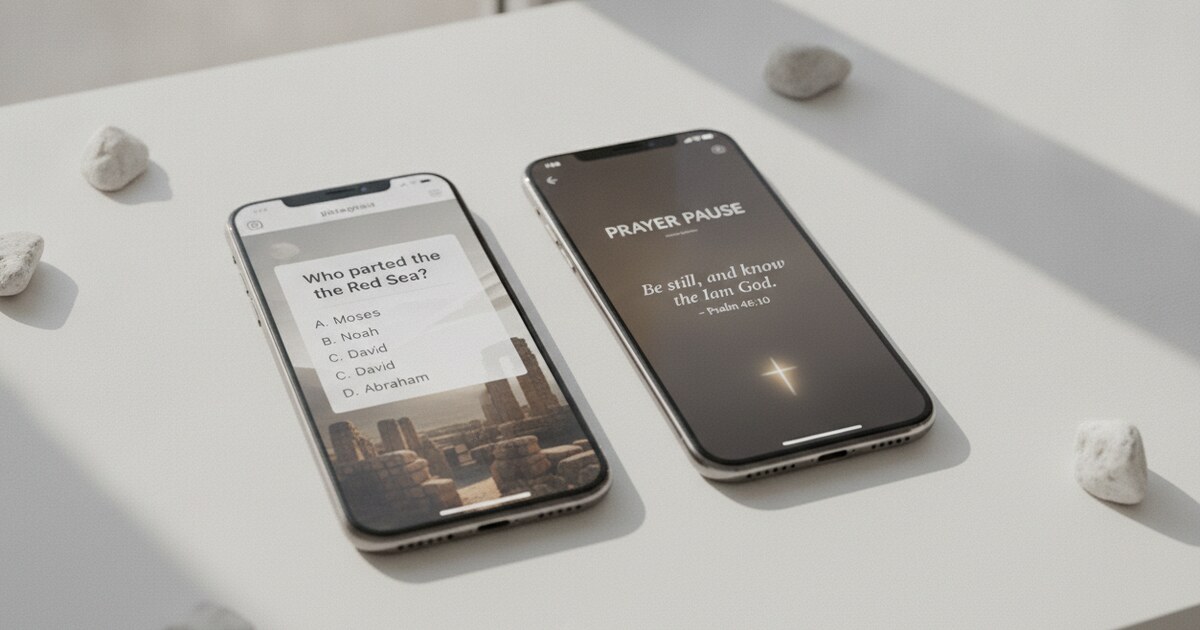
Tap Instagram or TikTok, and instead of opening the app, FaithLock shows you a Bible verse and a multiple-choice comprehension question. Answer correctly and the app unlocks. The quiz takes 30-45 seconds of genuine engagement per session.
The format is deliberate. Most faith-based app gates show you a verse and ask you to tap “I’ve read it.” That’s recognition-level processing: your eyes pass over the words, you tap through. FaithLock requires production-level processing. You read closely enough to select the right interpretation from four options. Skimming doesn’t get you through.
For a deeper look at the quiz mechanics and accountability features, the FaithLock app review covers the full picture.
Beyond the basic gate, FaithLock builds an accountability layer on top. You set a 30-day spiritual covenant, name partners who receive your progress reports, and review analytics showing how many times you tried to open gated apps and how many times you resisted. That social accountability component is unique in the category. Most lock-app tools are private by design; FaithLock makes the data visible to people who care about your growth.
The platform limitation is the biggest drawback. FaithLock is iOS-only. Android support has appeared in the “coming soon” section for over a year without shipping. There’s also no meaningful free tier: you pay from day one.
The best Christian app blocker roundup covers all seven active options in the category if you want to see how FaithLock stacks up against the full field.
The Christian app blocker category grew from 2-3 apps in 2022 to more than 7 by mid-2026, driven by Pew Research data showing 62% of U.S. Christians say they spend too much time on their phones and IDC data showing 79% of smartphone users reach for their device within 15 minutes of waking. DataReportal 2025 reports the average person spends 4 hours and 37 minutes daily on their phone. FaithLock’s quiz mechanic draws on active recall research: production-level recall (answering a question) requires deeper processing than recognition-level recall (reading a verse). The 30-day covenant structure aligns with Phillippa Lally’s 2010 UCL habit study, which found initial behavioral change thresholds form in 21-30 days even when full habits take longer. The quiz format limits the common tap-through failure mode in single-verse gates. iOS-only availability excludes the 44% of global smartphone users on Android, the largest underserved segment in the category.
How Bible Pause Works
Bible Pause takes the opposite bet. It’s built on the conviction that shame and hard locks don’t produce lasting habit change. Awareness does.
Open a gated app and Bible Pause interrupts the screen. A short prayer appears. A Bible verse follows. A reflection prompt asks how you’re feeling right now. Then it offers a choice: continue, or close and do something else.
You can say continue. The app won’t stop you. That’s the whole design.
The developers state the philosophy plainly: “No shame, no punishment, just awareness, prayer, and choice.” For users who find hard blocks counterproductive — people who delete apps, find workarounds, or treat friction as an adversarial game — this posture actually makes sense. A soft gate that builds mindfulness may work better long-term than a firm gate that builds resentment.
The Bible Pause app review covers the specific prayer prompt categories and how the gate experience varies throughout the day.
There’s no quiz or accountability tracking, and no log of failed attempts. Privacy is a design priority: no data leaves your device. No behavioral tracking, no upload of unlock patterns, nothing sent to a server. For users who are sensitive about apps monitoring their phone habits, that matters.
The pricing is the sharpest criticism. Bible Pause charges $14.99 per week or $129.99 per year. That’s the highest price point in the Christian app blocker category. A comparable firm blocker typically costs a fraction of that annually. For what amounts to a prayer prompt before each app open — with no hard lock enforcing the choice — the cost-to-friction ratio is hard to justify unless the soft-gate philosophy genuinely resonates with how you’re wired.
Bible Pause runs on iOS 16.0 or later. Android is not available.
FaithLock vs Bible Pause: Head-to-Head
Neither app is obviously better. They’re built on different premises about human behavior and habit change.
| FaithLock | Bible Pause | Psalmo | |
|---|---|---|---|
| Gate type | Hard lock (quiz required) | Soft pause (your choice) | Hard lock (read verse to unlock) |
| Friction method | Bible quiz, 30-45s active recall | Prayer + verse + reflection | Today’s verse, once per day |
| Accountability | 30-day covenant, partners, analytics | None | Streak tracking (no shame) |
| Platforms | iOS only | iOS only | iOS and Android |
| Android | Not available | Not available | Available |
| Free tier | None | None | Yes (KJV and WEB) |
| Pricing | Subscription required | $14.99/wk or $129.99/yr | Freemium |
| Privacy | Standard | On-device only, no tracking | Standard |
| Home-screen widgets | None | None | Yes (3 sizes) |
| Lock-screen widgets | None | None | Yes (iOS 16+) |
| Shame-free design | Tracks failed attempts | Yes, by design | Yes (streaks reward, never punish) |
Which One Should You Choose?
FaithLock is the stronger pick if you know you can’t trust yourself to say no once the gate opens. The quiz mechanic creates genuine friction, not just a nudge. If you’ve tried other scripture gates and found yourself tapping through in 2 seconds without reading, the quiz format addresses exactly that failure mode. The accountability layer — covenant, partners, analytics — adds value for anyone doing this inside a small group, accountability relationship, or Bible study context where another person seeing your data matters.
Bible Pause makes more sense if hard locks create anxiety or a “rule to break” dynamic for you. Some people, when blocked from an app, spend energy resenting the barrier or finding a workaround instead of addressing the underlying habit. If your phone relationship is more about intentionality than compulsion, a moment of prayerful awareness before each scroll session — with the choice still yours — may build better long-term patterns than a test you can’t bypass.
The weakness both share: neither app provides passive scripture exposure. You only see a verse when you hit the gate. Scripture appears at your most vulnerable moment (the impulse to open Instagram) but not throughout the rest of your day. If you want the Bible visible on your home screen or lock screen as a constant ambient presence, neither app covers that.
What About Android Users?
Both FaithLock and Bible Pause are iOS-only. If you’re on Android — roughly 44% of smartphone users globally — neither works.
Psalmo is the main cross-platform alternative in the category. It gates selected apps (Instagram, TikTok, X, YouTube, Snapchat) until you read today’s Bible verse. Once you’ve read it, your apps open for the rest of the day. The gate runs on both iOS and Android with the same mechanic.
Psalmo also adds home-screen and lock-screen widgets. Three sizes on iOS and Android. Lock-screen accessories on iOS 16+. Fifteen-plus aesthetic themes from Classic and Dark to Watercolor, Night Sky, and Rose Gold. The widget layer means scripture is visible passively throughout your day, not only when you’re fighting an urge to scroll. FaithLock and Bible Pause are pure gate apps: scripture shows up when you’re trying to stop. Psalmo combines the gate with continuous scripture display.
The free tier covers KJV and WEB translations, both public domain. The daily verse gate and basic widgets are free from the start. AI features — generate a prayer, find a verse for your situation, explain a Bible passage — are premium.
Frequently Asked Questions
Is FaithLock better than Bible Pause? FaithLock is better for users who need a hard gate with accountability. The quiz mechanic requires genuine comprehension (30-45 seconds, active recall), and the covenant feature adds social accountability through partners who see your progress data. Bible Pause is better for users who want mindful awareness rather than enforcement. The right answer depends on whether hard locks change your behavior or create resentment.
Does Bible Pause actually block apps? Bible Pause pauses rather than blocks. When you open a gated app, it shows a prayer, a Bible verse, and a reflection prompt, then offers you the choice to continue. If you need an app that prevents access until you complete a specific action, FaithLock or Psalmo enforce the lock; Bible Pause doesn’t.
Are FaithLock and Bible Pause available on Android? Neither is available on Android as of August 2026. FaithLock has listed Android as coming soon for over a year without shipping. Bible Pause is iOS-first by design. Psalmo works on both iOS and Android with the same daily verse gate mechanic on both platforms.
What does each app cost? FaithLock requires a paid subscription with no meaningful free access to blocking features. Bible Pause costs $14.99 per week or $129.99 per year — the highest price point in the Christian app blocker category. Psalmo offers a real free tier using public-domain translations (KJV and WEB): the daily verse gate and basic widgets work without a subscription.
Do FaithLock or Bible Pause include home-screen widgets? Neither includes home-screen or lock-screen widgets. Both are pure gate apps: scripture only appears when you try to open a blocked app. Psalmo combines the daily verse gate with home-screen widgets in three sizes (iOS and Android) and lock-screen widgets (iOS 16+), so scripture stays visible throughout the day and not only at the gate.
Psalmo is free to download on iOS and Android. It blocks the apps that pull you away until you’ve read today’s verse, and adds scripture to your home screen and lock screen between those moments. Download on the App Store or Google Play.