Want a verse on every screen? Psalmo is free.
Christian Phone Setup: Widgets, App Gates & Faith Apps
You unlock your phone around 144 times a day. Most of those unlocks don’t start with a plan. You reach for it, Instagram opens, and 15 minutes disappear. A Christian phone setup flips that reflex by building a device that puts Scripture in front of you before anything else gets the chance.
A Christian phone setup has 4 layers: a Bible verse widget on your home screen, lock-screen Scripture on your iPhone, an app gate that pauses social media until today’s verse is read, and a curated faith app stack. Start with one layer this week and build out the rest as each becomes routine.
None of this requires technical expertise. Every layer takes under 10 minutes to configure.
What a Christian Phone Setup Actually Includes
The science of habit formation explains why your phone environment matters more than your intentions. Phillippa Lally’s 2010 UCL study tracked 96 participants building new behaviors and found the median time to automaticity was 66 days, with location-based cues being the strongest trigger. Your phone’s home screen is the most-visited environment in your day. DataReportal 2025 reports the average person unlocks their phone 144 times daily; Pew Research 2024 found 62% of U.S. adults identify as Christian, with 45% of those using their phone for faith-related activities every day. iOS 16 (released September 2022) brought lock-screen widgets to iPhone, adding a Scripture surface visible on every device wake. Android WorkManager (API 23+) powers background verse refresh on Pixel, Samsung, and Motorola devices. A complete 4-layer Christian phone setup covers every natural touch-point in a day: the morning pick-up, passive mid-day unlocks, intentional Bible reading, and the late-night scroll temptation.
The 4 layers work together but can be built one at a time. Most people start with the home screen widget, then add the lock screen a week later, then wire in gating once the habit feels settled.
How to Build Your Christian Phone Home Screen
The home screen’s top section is where your eye lands first after unlocking. Most phones ship with social apps and a browser gridded there by default. Moving a Scripture widget into that spot costs 60 seconds and shifts what greets you every time the screen lights up.
Pick a widget size. Psalmo offers 3 home-screen widget sizes: small (2x2 tile, verse reference only), medium (2x4 banner, full verse plus reference), and large (4x4 block, verse with full display). The medium widget placed at the top of your home screen balances readability with enough space below it for other apps.
Choose a theme. Psalmo’s free tier includes Classic, Dark, and Minimal. Premium unlocks Marble, Rose Gold, Watercolor, Night Sky, Stained Glass, and 10 others. The theme matters for one practical reason: a widget that looks like yours is one you’ll actually read. A jarring color scheme gets visually dismissed within a week, and you’ll stop seeing it. Choose something you’d want on a phone case.
Relocate social apps. You don’t have to delete Instagram. Moving it to a second page or a folder breaks the reflex tap without requiring you to cut the apps entirely. Screen Time on iOS and Digital Wellbeing on Android both add a tap-to-confirm layer. If you’re turning on Psalmo’s app gate (Layer 3 below), the apps can stay visible on the home screen since the gate handles the pause.
For more setup ideas and aesthetic combinations, the Christian Home Screen Aesthetic guide covers 5 complete setups by visual style.
Lock Screen Scripture: iPhone and Android Options
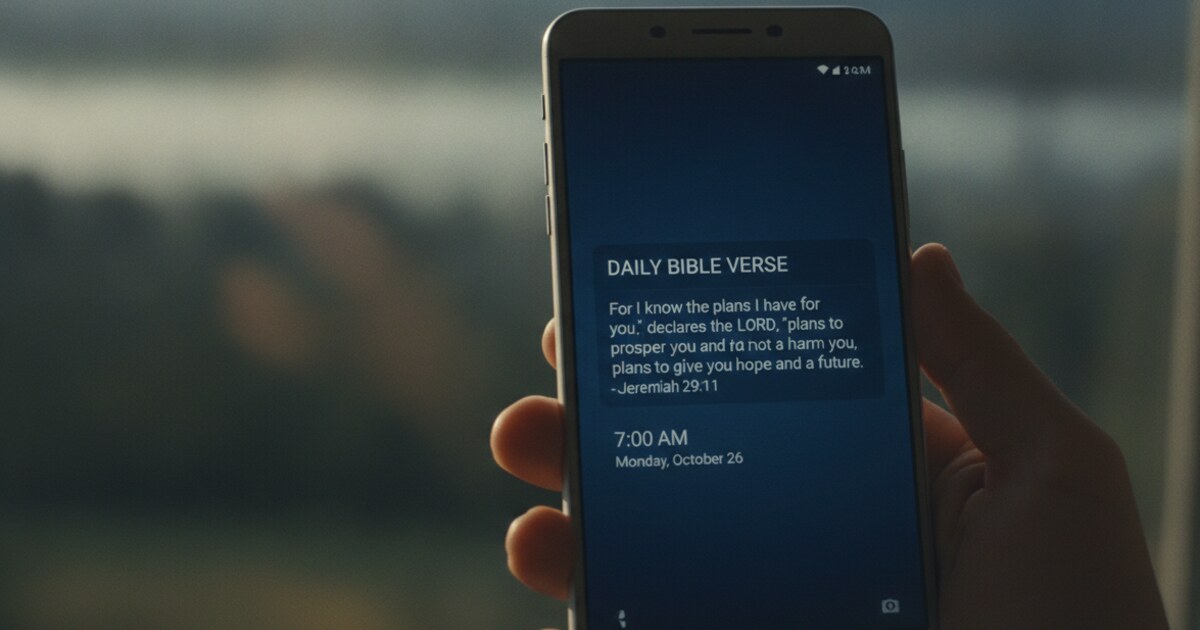
The lock screen appears every time your phone wakes, which is every one of those 144 daily unlocks. Placing Scripture there takes under 3 minutes on iPhone and under 1 minute on Android.
iPhone (iOS 16+). Long-press your lock screen, tap Customize, select Lock Screen, then tap the widget bar below the clock. Tap the plus sign, search Psalmo, and add it. Three accessory shapes appear: rectangular (a full short verse), circular (verse reference only), and inline (the opening phrase in line with the time). Rectangular fits the most text and works best for daily Scripture use.
iPhone Standby (iOS 17+). If you charge your iPhone face-up on a nightstand, iOS 17’s StandBy mode displays full-screen widgets while charging. Adding Psalmo to a StandBy page turns your bedside setup into a Scripture display visible from across the room.
Android. Android removed lock-screen app widgets in Android 5.0 (2014). That’s a platform constraint. The practical alternative: generate a verse wallpaper image inside Psalmo (open the verse, tap Share, save the image), then set it as your lock-screen wallpaper. It won’t rotate automatically, but you can swap it weekly as a simple Sunday habit.
For the full step-by-step iPhone setup, see How to Add a Bible Verse Widget to Your iPhone.
App Gating: Requiring Scripture Before Social Media Opens
A widget is passive. It shows Scripture whether or not you read it. An app gate is active: it requires you to read today’s verse before a social app opens. That difference in friction is where most of the behavior change actually comes from.
How it works in Psalmo. Open the app, go to Settings, and tap “Lock Apps Until You Read.” You’ll see a list of apps to gate: Instagram, TikTok, X, YouTube, Snapchat, or any installed app on your device. Toggle the ones you want gated. The next time you open one of those apps, Psalmo shows today’s verse first. Tap Done after reading and the app unlocks for the rest of the day. The gate resets at midnight, and you can turn any gate on or off whenever you want.
Why this holds when willpower doesn’t. Behavioral research consistently shows that environmental friction matters more than motivation. A 10-15 second Scripture pause before Instagram doesn’t require heroic effort. It only requires showing up once. Most people report the habit feeling automatic within 3-5 weeks, well inside the 66-day ceiling from Lally’s research. The gate doesn’t shame you if you skip a day. It just resets.
The app gate works identically on Android and iPhone. The lock-screen widget limitation on Android has no effect on gating at all.
For more on the behavioral angle, see the Christian App for Phone Addiction guide.
The Faith App Stack
A useful Christian phone setup pairs Psalmo with one or two complementary apps. Psalmo handles home-screen widgets, lock-screen Scripture, app gating, and AI verse lookup (premium). What it doesn’t include: a full Bible reader, structured reading plans, or guided audio prayer. Those gaps are worth filling intentionally rather than letting random downloads fill them.
For Bible reading. Psalmo’s daily verse and premium “Find a verse for my situation” prompt aren’t substitutes for chapter-by-chapter reading. If you want reading plans or access to multiple translations, YouVersion is free, carries 2,500+ translations, and doesn’t paywall the core Bible text. It runs alongside Psalmo without any overlap.
For prayer. Psalmo premium includes “Write a prayer for me” and “Reflect on my week” prompts for short AI-assisted prayer. For longer structured sessions, Hallow (Catholic and liturgical, $69.99/year) and Glorify (evangelical, $6.99/month) go deeper with guided audio. PrayerMate is free and works for organized intercession lists on both iOS and Android.
What to remove first. Before adding any new apps, audit what’s already installed. Any app you open without a goal and can’t stop at one scroll is a candidate for gating or deletion. The FOMO cost of removing it drops to near zero within 10 days. Clearing that space first makes the rest of the setup more effective.
Frequently Asked Questions
How do I set up a Christian phone from scratch?
Start with Psalmo: install the app, pick a widget size and theme, and place the widget at the top of your home screen. Move social apps off page one. That’s the foundation. Layers 2-4 (lock screen, app gate, faith app stack) can each be added in separate 10-minute sessions over the following week. Starting all 4 at once is possible, but one at a time tends to stick better.
Does a Christian phone setup work on Android?
Yes. Psalmo’s home-screen widgets and app gating both work on Android (any device running API 23 or later). The one gap is the lock-screen widget: Android removed support in Android 5.0 (2014), so the lock-screen layer uses a static verse wallpaper image instead of a live widget. Home-screen widgets and gating are fully functional on Android.
Do I need to pay for a Christian phone setup?
The core setup costs nothing. Psalmo’s free tier includes 3 widget themes (Classic, Dark, Minimal), daily verse display, and app gating. YouVersion is fully free for reading plans and Bible access. Premium tiers on Psalmo, Hallow, and Glorify add features, but a functional 4-layer Christian phone setup can be built entirely on free tools.
Can I use Psalmo alongside YouVersion and other Bible apps?
Yes. Psalmo is designed to complement full Bible apps, not replace them. Most users run Psalmo for widgets and gating, YouVersion for reading plans, and a prayer app for guided devotionals. The three cover different jobs and don’t duplicate each other in any meaningful way.
Can I choose which Bible verse appears each day?
Psalmo draws the daily verse from the categories you’ve toggled on. There are 15+ categories: Faith, Peace & Anxiety, Morning Verses, Evening Verses, Strength, Gratitude, Healing, and others. You can’t select a specific verse for a specific day, but you control which categories feed the rotation. KJV and WEB (World English Bible) are both available and switchable in Settings.
Psalmo is free to download on iOS and Android. A complete Christian phone setup takes under 45 minutes total and runs on its own from there.