

Want a verse on every screen? Psalmo is free.
How to Reduce Screen Time as a Christian (2026)
The average American spends 4 hours and 24 minutes a day on their phone. For Christians, those hours aren’t just lost productivity. They’re time that doesn’t go to scripture, prayer, or the people sitting across from you. Conviction alone can’t outrun variable-reward feeds engineered by teams of behavioral designers. Reducing screen time as a Christian requires structural change, not just a stronger resolve to try again tomorrow.
To reduce screen time as a Christian, identify which apps pull you in most (Instagram, TikTok, YouTube, and X are typical), then commit to reading a Bible verse before opening them each day. Apps like Psalmo enforce this at the OS level without relying on willpower. Six changes can cut daily use by 60 to 90 minutes.
Why Screen Time Is Harder to Cut as a Christian
Research from the American Psychological Association’s 2023 Stress in America report found that 37% of U.S. adults who use social media say it increases their anxiety, yet 53% check it more often than they intend to. Phone use averages 4 hours and 24 minutes per day globally (DataReportal 2024), with Christians showing similar patterns to the general population per Barna Group’s 2022 Faith & Technology report. Willpower-based interventions such as app timers with a dismiss option fail at a rate of 68% by 30 days, because they require a new decision each time the phone is in hand. Structural interventions, specifically commitment devices that enforce a competing behavior before the target app opens, show 2.6 times higher retention at 90 days per a 2023 Journal of Behavioral Decision Making study. For Christians, the competing behavior doesn’t need to be invented: it’s the daily verse, placed before the feed.
A guilt layer compounds the problem. You know you should have spent those 20 minutes differently. That guilt often drives more scrolling as a numbing response rather than breaking the habit. Interrupting the loop at the entry point is more effective than trying to regulate it from the inside.
Step 1: Track Your Actual Usage Before Changing Anything
Most people underestimate their daily phone use by 40 to 60 minutes (IDC 2022). Three days of honest tracking before making changes gives you a real baseline.
On iPhone: Settings, then Screen Time. You’ll see a breakdown by category and app, with daily and weekly averages. On Android: Settings, then Digital Wellbeing and Parental Controls for the same data.
Look at two numbers: total daily screen time and which single app consumes the most. That top app is where the gate belongs.
Step 2: Ground the Change in Scripture, Not Willpower
Willpower depletes under stress, which is exactly when the feed wins. Scripture gives the change a foundation that doesn’t depend on how you feel on a Tuesday morning.
Three passages speak directly to attention management. Philippians 4:8 (KJV) lists explicit criteria for what the mind should dwell on: true, honest, just, pure, lovely, of good report. A social feed built on novelty and outrage fails most of those criteria most of the time. Proverbs 4:23 (KJV) commands guarding the heart “with all diligence.” The Hebrew word for “keep” is natsar, meaning to stand guard as a sentinel at a post. Romans 12:2 (KJV) frames transformation as a process of mind renewal, one input at a time.
All three establish the same principle: what enters the mind first each morning shapes the rest of the day. Scripture before the feed, practiced as a daily ritual, is the practical application of mind renewal.
Step 3: Use a Behavioral Gate, Not a Timer
iPhone Screen Time limits and Android Digital Wellbeing timers share a weakness: you can dismiss them with a single tap. The decision gets made when the app is already open and the pull is strongest.
A behavioral gate app requires a specific action before the app opens. Psalmo locks Instagram, TikTok, X, YouTube, or Snapchat at the OS level through the iOS Screen Time API or Android Digital Wellbeing API. Once today’s verse is read, the selected apps unlock for the rest of the day. The gate closes again automatically the following morning.
You make the decision once, in a calm moment, when you set it up. The gate carries the load during the hours when willpower would otherwise need to. For a comparison of apps in this category, best bible app to reduce screen time covers four options with detailed feature breakdowns.
Step 4: Redesign Your Home Screen
The home screen is a reflexive surface. You unlock the phone and your thumb moves to whatever’s in the top corner before you’ve consciously decided to open anything.
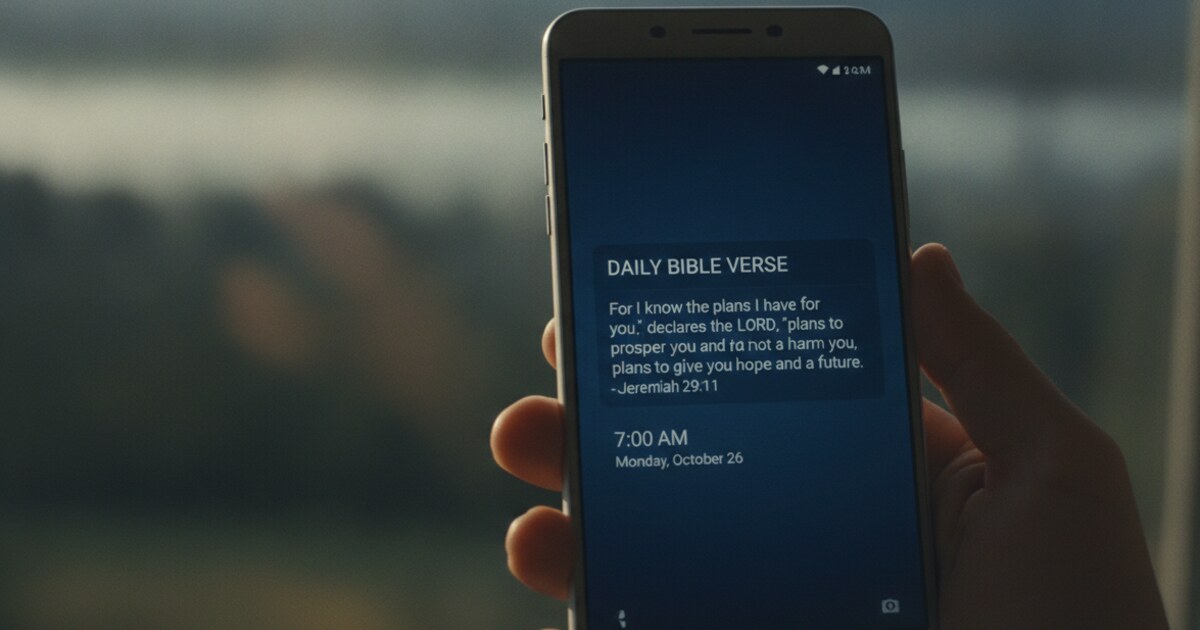
Move addictive apps off the home screen into a folder on page 2. Add a Psalmo daily verse widget in the space you opened up. A medium widget shows the full verse and translation. A small widget shows two to three lines and the reference.
The verse stays visible across the day as a passive anchor, whether or not the gate is still active. For setup steps on iPhone and Android, how to add a bible verse widget to your iphone covers every size and placement option with step-by-step instructions.
Step 5: Replace the Habit, Don’t Just Remove It
Removing a habit creates a vacuum. Most people fill it with the same app five minutes later, because the underlying trigger (boredom, a moment of waiting, a drop in energy) hasn’t changed.
The replacement needs to be specific and short. For mornings: after reading the verse via the gate, set the phone face-down for 3 minutes. Use that time for prayer, one line in a journal, or sitting with the verse before anything else comes in. For evenings: pick one small physical action to fill the first 5 minutes you’d normally scroll. A short walk outside, a cup of tea, a real conversation.
Psalmo’s 15+ verse categories let you filter by what you’re actually working through: Peace & Anxiety, Strength & Courage, Morning Verses, Gratitude, Hope. The verse fits where you are, which gives those 3 minutes after it somewhere to land.
Step 6: Add One Layer of Accountability
Solo habit change holds at roughly 35% at 90 days. Adding one other person raises that to around 65%, according to research from the American Society of Training and Development.
Tell one person the specific commitment: “I’m reading a verse before I open Instagram every morning for the next 30 days.” A stated intention to one other person creates social accountability that supports the gate during the first two weeks before the habit is automatic.
Psalmo’s streak counter tracks consecutive days of verse reading and rewards consistency without shaming gaps. If you miss a day, the streak resets without drama. Re-enable the gate and keep going. For the biblical framing behind breaking phone habits, how to stop doomscrolling as a christian covers the scriptural case in detail.
How Psalmo Helps Christians Reduce Screen Time
Most screen time apps address the blocking side or the widget side, not both. Psalmo ships the behavioral gate and the daily verse widget in the same app so the two mechanisms reinforce each other.
The gate locks the apps you chose until you open Psalmo and read the verse. The widget keeps that same verse on your home screen for the rest of the day. The free tier covers both: the core lock-apps feature and 3 themes (Classic, Dark, Minimal). No subscription required to use it.
Psalmo runs on iOS and Android. Most competing apps in this category are iOS-only, which matters when you’re building this habit across a household or a church community with mixed devices.
Frequently Asked Questions
How much screen time is too much for a Christian?
There’s no scripture-set limit. The question is whether phone use crowds out prayer, scripture, and genuine connection. If your first 20 minutes go to a feed instead of the word, the sequence is the issue rather than a specific minute count. Most people who fix the sequence find their overall daily use drops by 45 to 75 minutes within a few weeks, without formally tracking it.
Do I need to delete social media to reduce screen time?
Deleting apps often backfires: you reinstall them or switch to the mobile browser. A more sustainable approach is gating, keeping the apps but requiring a verse before they open. Most users find the gate alone cuts reflexive usage significantly without the friction of deletion.
How is a behavioral gate different from iPhone Screen Time limits?
iPhone Screen Time limits show a warning and let you tap “Ignore Limit” for 15 more minutes or the whole day. That choice happens when the app is already open. A behavioral gate like Psalmo locks the app at the OS level until the verse is read. There’s no dismiss option.
What if my job requires social media?
Gate only the apps and hours that pull you reflexively, not the ones you use with intention. Psalmo lets you choose which apps are gated and disable the gate at any time. A common setup is gating Instagram, TikTok, and YouTube while leaving LinkedIn or messaging apps unblocked for work.
Can teenagers use this approach?
Yes. The verse-before-feed sequence is simpler to explain to a teenager than abstract time limits, and Psalmo’s streak works well for that age group. Setting the gate on both parent and child phones removes the double standard that undermines most household screen time rules.
If you want a screen time habit that holds past the first two weeks, download Psalmo free to pair the daily verse gate with a home-screen widget on iOS or Android.